

This article and all of its content were generated entirely using AI technology. Read more about how we work with AI.
This guide takes a neutral, fact-based look at something many technicians, service firms, and property owners already struggle with: should service logs live in a digital system, or stay in the familiar paper binder on the wall?
Both approaches have their strengths, but industry data shows a clear direction. Let’s walk through it.
The Paper Binder: Familiar, But Fragile
For decades, service logs have lived in binders stored in technical rooms, undercentraler or workshops. It’s simple, it doesn’t require training — and everyone knows where it should be.
But reality is often different:
- Binders get misplaced or thrown out during renovations
- Pages fall out or fade over time
- New technicians rarely find the full history
- Information becomes impossible to share remotely
- Ownership changes break the documentation chain
Even experienced teams express frustration. As one Swedish service company put it in a case study:
“Vi hade länge sökt efter ett smidigt system… inga krångliga system behövs och inga papper tappas bort.”
Paper works — until it doesn’t. And when it fails, the cost is time, repeat work, and uncertainty.
Digital Service Logs: Why the Shift Is Accelerating
Across the Nordic region, digitalisation in service and maintenance is moving fast.
A 2025 SmartCraft Digimeter study shows:
- 87% of construction and service companies say digital tools are now critical for their operations
- 6 out of 10 report that digital systems already improve their workflows
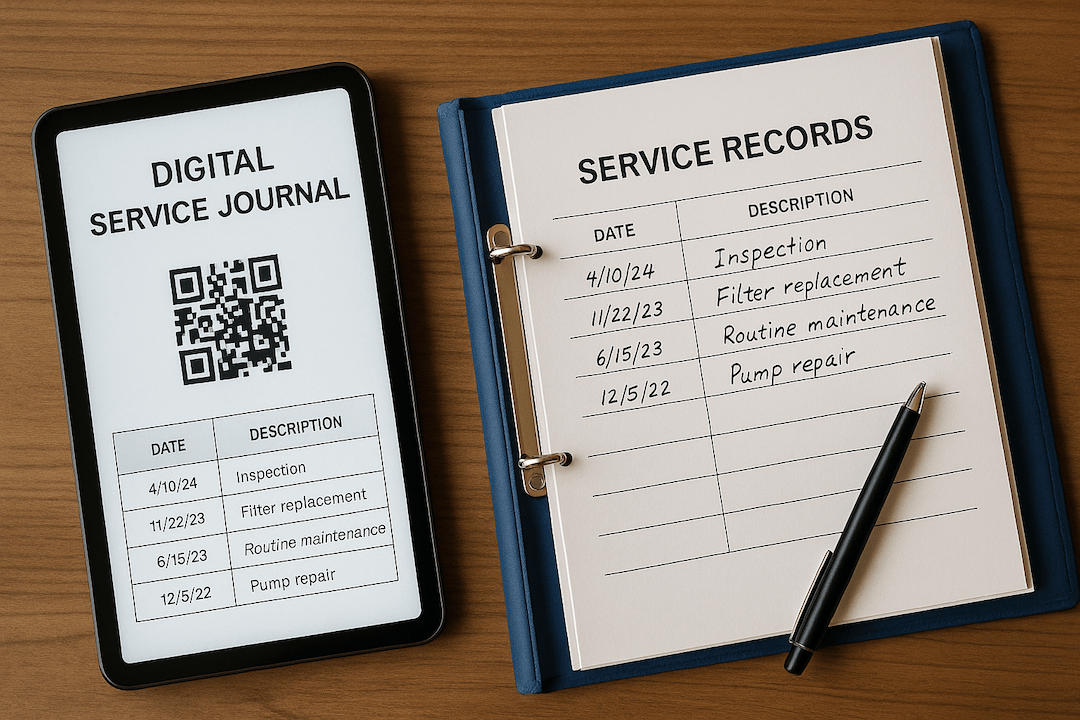
Service history is one of the areas where digitalisation has immediate impact. Instead of relying on a single binder in a locked room, technicians access everything through a smartphone — often by simply scanning a QR code.
What users appreciate most:
1. Time savings in the field
Technicians don’t waste minutes searching for binders or figuring out what happened last time. Everything is already there.
2. Fewer errors and better continuity
Digital logs reduce the risk of missing entries or forgetting details after the job. Each action is timestamped and stored safely.
3. Transparency for asset owners
Fastighetsägare want oversight. Digital logs provide:
- complete historical records
- traceability of who did what
- simple audits and inspections
4. Regulatory alignment
Industries like lifts, ventilation and safety systems already require long-term documentation. Digital platforms handle this automatically and securely — some sectors demand up to 30 years of retained service history.
What the Data Tells Us
The market research behind ASL reveals several clear trends:
- 35% of technicians feel existing digital systems are too complex — meaning there’s a demand for simpler tools, not just “more digitalisation.”
- Many companies report that information is scattered across Excel sheets, internal systems, paper notes and binders — leading to lost knowledge and inefficiency.
- Fastighetsägare increasingly expect traceability and instant access to service history, especially during audits or when switching contractors.
- Digital logs enable better preventative maintenance, reducing downtime and improving equipment lifespan.
One case example from a Swedish industrial company highlights the real-world shift: QR-based logging allowed technicians to check full history instantly and log new actions directly on-site — a huge improvement over the binder model.
When Paper Still Makes Sense
Although digital has major advantages, papperspärmar still have a role:
- They don’t require electricity, accounts, or training
- Some smaller sites prefer “low-tech but reliable” solutions
- In extreme environments (e.g., areas with no connectivity), paper is still a fallback
But as soon as information needs to be shared, passed between technicians, or stored for years, digital solutions win on reliability and accessibility.
The Balanced Conclusion
Both paper binders and digital service logs solve the same fundamental problem — documenting maintenance history. But they do so with very different strengths.
Paper
✔ Simple
✔ No devices needed
✘ Easily lost or incomplete
✘ Hard to share
✘ Not future-proof
Digital
✔ Searchable, sharable, secure
✔ Supports long-term compliance
✔ Faster for technicians
✔ Builds transparency for owners
✘ Requires trust in the system
✘ Needs to be simple to be adopted
The market is moving toward digital because the cost of missing or inaccessible information is getting higher — and the tools are getting easier.
Final Thoughts
This guide isn’t here to declare a winner — but to highlight a clear trend. Digital service journals aren’t replacing binders because they’re flashy. They’re replacing them because they solve the real, everyday problems technicians and property owners face.