

In technical maintenance, one question comes up again and again: What has been done here before?
The answer should be simple. In practice, it rarely is.
Technicians often arrive on site to service equipment that has been maintained for decades. The installation clearly has a history, but that history is fragmented. A paper binder may exist, but it is incomplete, outdated, or missing altogether. Handwritten notes are hard to interpret, and previous service providers may no longer be involved. In many cases, technicians are forced to rely on assumptions rather than facts.
This situation is not the result of poor work or lack of professionalism. It is a structural problem caused by how service documentation has traditionally been handled.
The Long-Term Problem with Paper Documentation
Paper-based service logs work reasonably well in the short term. Over time, however, they begin to fail. Buildings change ownership, service providers rotate, and staff members move on. Documentation is relocated during renovations or office moves, and responsibility for maintaining the binder becomes unclear.
After ten or twenty years, the documentation no longer reflects reality. Pages are missing, entries are inconsistent, and important context has been lost. When audits, inspections, or incidents occur, owners and operators struggle to demonstrate what work has actually been performed and when.
The result is not sudden failure, but gradual erosion of trust in the documentation itself.
The Cost of Missing History in the Field
For technicians, missing or unreliable service history leads to inefficiency. Time is spent rechecking components that may already have been inspected. Parts are opened unnecessarily. Preventive maintenance becomes guesswork rather than informed decision-making. This increases service time and introduces avoidable risk.
For property owners and facility managers, the consequences are equally serious. Poor documentation complicates handovers, weakens accountability, and increases dependence on individual knowledge rather than shared records. Over time, this creates operational risk and higher lifecycle costs.
A Minimal Intervention with a Disproportionate Effect
What is striking is how small the required intervention can be.
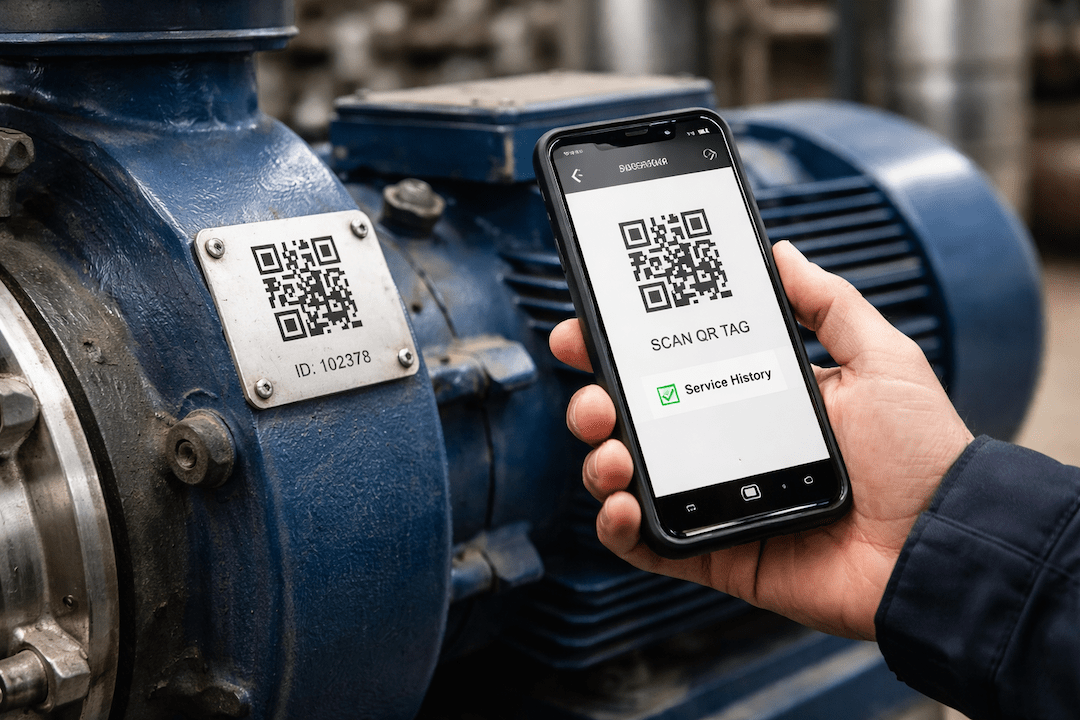
By placing a single QR tag directly on the asset, the service history becomes permanently linked to the physical installation. Scanning the tag provides immediate access to the complete maintenance record, regardless of who previously serviced the equipment or which organisation currently manages it.
The workflow itself does not change significantly. Technicians still perform their work on site and log their actions. Owners still oversee maintenance as before. The difference is that the documentation now follows the asset instead of being tied to a location, a binder, or a specific service provider.
Why Asset-Centered Documentation Works
This approach succeeds because it removes dependency on memory, location, and organisational continuity. The QR tag is always in the right place. The information is always accessible at the moment it is needed. No one needs to search for documentation or wonder whether it is complete.
Over time, this creates a stable and trustworthy service history that survives staff changes, contractor changes, and ownership changes. Instead of trying to reconstruct the past, teams can focus on maintaining the asset properly in the present.
A Shift in Perspective, Not Just Technology
QR codes and digital logs are not new technologies. The real shift is conceptual. Service history should belong to the asset itself, not to a binder, a contractor, or a proprietary system that may be replaced.
When documentation is anchored to the asset, continuity becomes the default rather than the exception. The accumulation of paper chaos simply stops.
Conclusion
Many organisations spend years attempting to clean up historical documentation after problems emerge. This is costly and rarely fully successful. Preventing the problem in the first place is far more effective.
A single QR tag may seem like a small step, but when placed correctly, it can replace decades of fragmented paper records and create long-term clarity. In maintenance, small structural changes often have the largest impact.